
Which Non-Surgical Treatment Is Best for Sagging Jowls?
As we navigate the natural aging process, our lower face often undergoes a noticeable shift. The crisp, defined jawline of youth gradually gives way to soft, sagging tissue along the jaw, commonly known as jowls. When looking to restore a sharp profile without undergoing invasive plastic surgery, most patients find themselves comparing two highly popular clinic treatments: a medical thread lift and injectable dermal fillers.
While both procedures are non-surgical and offer immediate improvements, they operate on completely opposite biophysical mechanisms. Understanding the difference between a thread lift vs fillers is essential to choosing the treatment that aligns with your anatomy.
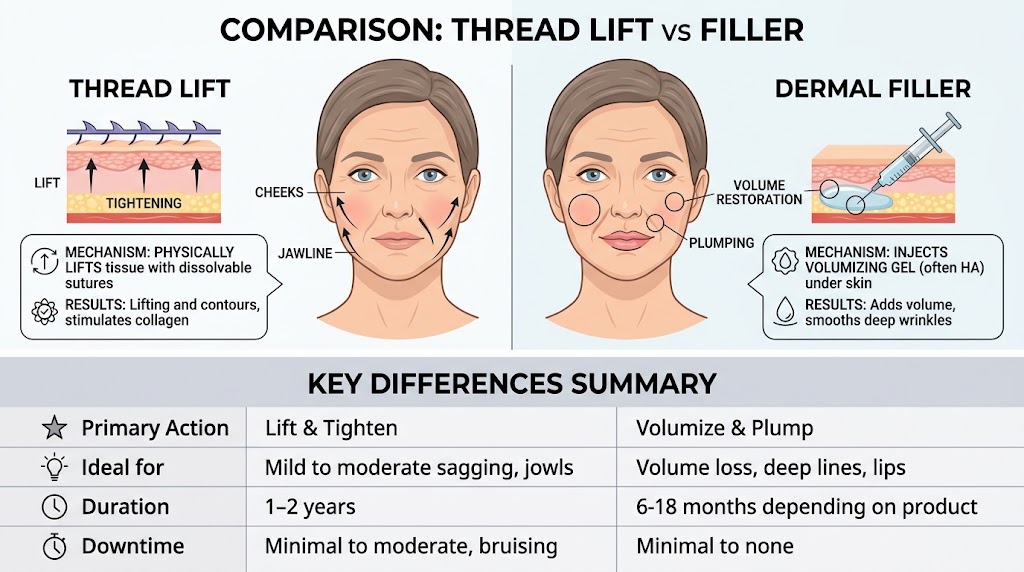
When your primary concern is structural sagging—meaning your facial tissues have physically shifted downward due to gravity and weakened ligaments—your skin requires mechanical repositioning. This is where a thread lift excels.
Unlike injectables, a customized thread treatment involves inserting medical-grade absorbable sutures equipped with microscopic barbs into the subcutaneous tissue layers. The doctor physically anchors, lifts, and pulls the displaced fat pads back up to their original position, creating an instant V-shape contour. Over the following months, the dissolving material triggers deep collagen synthesis, ensuring the newly lifted jowls remain firmly in place.
In contrast, dermal fillers are formulated with smooth, gel-like hyaluronic acid or calcium hydroxylapatite. Fillers do not possess the mechanical strength to physically pull or lift large amounts of heavy, sagging tissue. Instead, they are designed to restore lost volume.
As we age, we naturally lose deep fat pads and undergo bone resorption in the cheeks and temples, causing the overlying skin to deflate and drape downward. By strategically placing fillers along the cheekbones or the posterior jaw angle, an experienced doctor can create an optical illusion of a lift by re-inflating the empty facial matrix. However, if fillers are over-injected into already heavy, sagging jowls, it can inadvertently make the lower face look wider or unnaturally puffy.
@draidilidealyst @Dr Aidil Idealyst Clinic #FYP #aestheticdoctor #idealystclinic #docideal #mounjaro ♬ original sound - Doc Ideal
Choosing between a thread lift vs fillers comes down to assessing whether your face requires volume replenishment or a physical directional lift:
For patients experiencing a combination of both severe sagging and volume loss, combining these two modalities within a structured treatment plan often yields the most natural, multi-dimensional rejuvenation. Dive deeper into the advanced mechanics, safety protocols, and longevity of structural positioning in our definitive guide to the [pdo thread lift]
Yes. It is common practice to perform a mechanical lifting procedure first to reposition sagging tissues, followed immediately by targeted filler micro-injections to polish up specific hollow areas like the temples or chin.
High-quality dermal fillers typically last between 9 to 18 months depending on the product density. A professional thread lift provides structural lift for 12 to 18 months due to the long-lasting collagen scaffold built around the dissolving threads.